
Sile's Take on Atkins Diet


Beta Oxidation
This process occurs after the initiation process. Beta oxidation occurs in the mitochondrial matrix. It involves a series of reactions. The reactions are as follows:
-
Two hydrogen between the second and third carbons in the carbon chain of acyl-CoA with the help of acyl-CoA dehydrogenase. Trans enoyl-CoA is formed and FAD+ is reduced to FADH2 (Oregon State Biochemical Department, 2017).
-
Enoyl-CoA is hydrolysed and 3-L-hydroxyacyl-CoA is formed. The reaction is catalyzed by enoyl-CoA (Oregon State Biochemical Department, 2017).
-
3-L-hydroxyacyl-CoA is oxidized with the assistance of 3-L-hydroxyacyl-CoA dehydrogenase to form 3-ketoacyl-CoA and NAD+ is reduced to NADH (Oregon State Biochemical Department, 2017).
-
Acetyl-CoA and an acyl-CoA two carbons shorter than the normal one are created by the breaking down of acyl-CoA, catalyzed by betaketothiolase (Oregon State Biochemical Department, 2017).
Acetyl-CoA will go through the kreb's cycle to produce ATP (Oregon State Biochemical Department, 2017) and the NADH and FADH2 will go through the electron transport chain and oxidative phosphorylation. The net number of ATP molecules produced in the full oxidation of palmitic acid is 129 (Chris, 2014). 8Acetyl-CoA, 7 NADPH2, and 7 FADH2 (Chris, 2014).
For more information, click here.
Questions
-
Beta oxidation occurs in the mitochondrial matrix.
-
3-L-hydroxyacyl-CoA is formed.
-
Beta oxidation occurs after the initiation process.
-
An acyl-CoA two carbons shorter than the previous one.
-
Betaketothiolase catalyzes the break down of acyl-CoA.
Answers
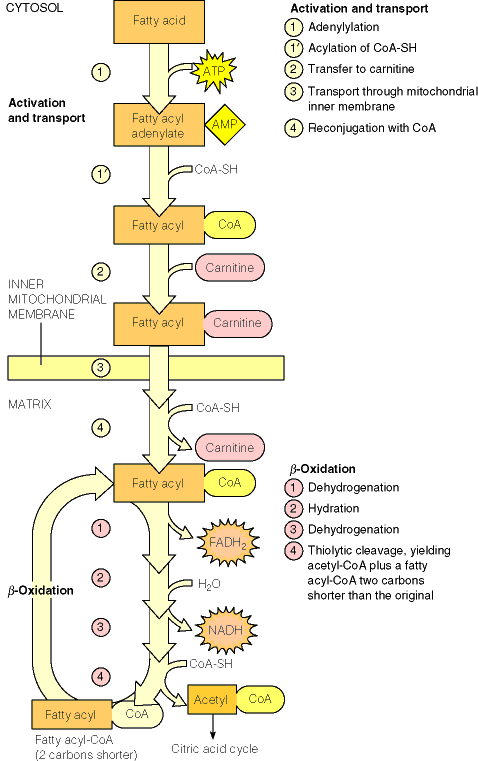
(Oregon State Biochemical Department, 2017)